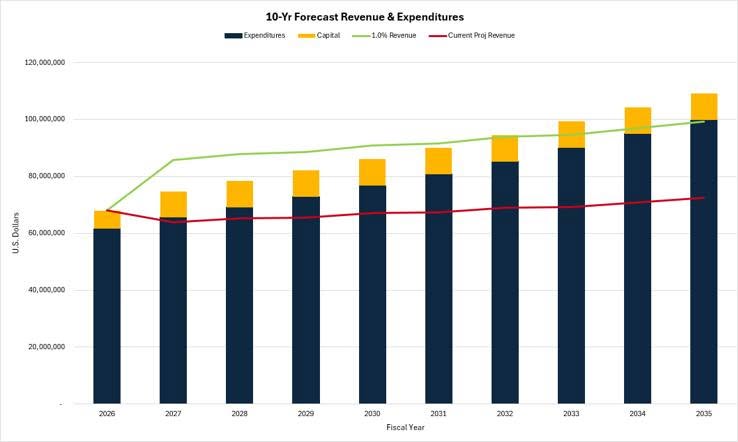
With the November 3 election approaching, it’s important to understand why Arvada Fire Protection District selected a proposed 1% sales tax rather than an additional property tax mill levy for Arvada Fire Issue 6C.
The decision involves more than simply raising revenue. It involves the long-term financial stability of fire and emergency services, changes in Colorado property tax laws, voter preferences, and what neighboring fire districts are proposing.
Here are the important facts.

1. COLORADO PROPERTY TAX LAWS HAVE CHANGED
Colorado’s HB24B-1001 changed portions of the property tax system, including assessment rates, taxable value reductions, and certain limits on property tax revenue growth.
As a result, increasing property values do not necessarily translate into proportional revenue increases for fire districts.
An additional mill levy would continue to depend on property assessments and applicable state legislation.
A sales tax provides a different revenue source, reducing the district’s direct dependence on property tax assessment rules.
Neither funding source is immune from future legislation, but diversifying revenue can reduce dependence on any single funding mechanism.
2. BOTH OPTIONS WERE PROJECTED TO RAISE THE SAME AMOUNT
The district evaluated two alternatives:
 Property tax increase: 7.25 mills
 Sales tax increase: 1%
Both were projected to generate approximately $23.1 million in their first year.
The distinction is how the revenue is generated.
A property tax increase places the additional burden on taxable property.
A sales tax spreads the additional tax across taxable purchases, including purchases made by nonresidents.
However, sales tax collections fluctuate with consumer spending, while property taxes have different economic and legislative risks.
The choice is not simply about the amount collected. It is about the long-term reliability and diversification of district revenue
3. WHAT DID ARVADA VOTERS SAY?
In March 2026, Magellan Strategies surveyed 977 registered voters.
The results showed:
 Support for a 1% sales tax:
Initially: 66%
After additional information: 70%
Support for a 7.25-mill property tax increase:
Initially: 54%
After additional information: 58%
When voters were asked which funding mechanism they preferred:
51% selected the sales tax.
17% selected the property tax.
18% preferred neither.
14% were unsure.
Additionally, 79% approved of Arvada Fire’s service performance.
These are survey results, not predictions of the November election. Nevertheless, the survey clearly documented greater stated support for the sales tax approach
4. THE FINANCIAL PLAN IS ABOUT TEN YEARS, NOT JUST ONE
One important aspect of the district’s financial strategy is the use of reserves.
The objective is not necessarily to collect more revenue than the district spends every single year.
Instead, the financial model anticipates building reserves during earlier years when revenues exceed expenditures.
Importantly, Arvada Fire Protection District has already documented a three-month operating reserve requirement in its 2024 Community Risk Assessment and Standards of Cover. This money may be identified as a surplus but is actully held in reserve.
Those reserves above the three-month reserve requirement can then help pay for operating expenses and major capital replacements in later years.
This is particularly important for fire districts because equipment and apparatus replacements are expensive and do not occur evenly from year to year.
For example, the survey materials identified:
 Fire engine costs increasing from approximately $755,000 in 2020 to $1.37 million in 2026.
 Heart monitor costs increasing from approximately $33,000 in 2013 to $57,000 in 2026.
The financial question is whether cumulative revenues and available reserves can support district operations and capital requirements over the full planning period.
A single year in which expenditures exceed revenues does not necessarily indicate a financial problem if sufficient reserves have been accumulated.
5. ARVADA IS NOT ALONE IN PROPOSING A FIRE DISTRICT SALES TAX
This is an important part of the discussion that deserves attention.
Four neighboring fire districts have sales tax proposals under consideration in the November 2026 election:
Arvada Fire — Issue 6C: 1.00%
West Metro Fire — Issue 7C: 0.75%
Adams County Fire: 1.00%
Evergreen Fire — Issue 7B: 0.89%
If all four proposals pass, Arvada would not be the only district introducing an additional fire protection sales tax.
Consider a $1,000 taxable purchase.
The difference attributable solely to these proposed fire district taxes would be:
Arvada vs. Adams County Fire: $0
Arvada vs. West Metro Fire: $2.50
Arvada vs. Evergreen Fire: $1.10
This does not mean the total sales tax rates would be identical. Existing city, county, and other district taxes must also be considered.
But it does mean that any comparison of regional business competitiveness should account for what happens if neighboring districts also approve their measures.
6. WHAT ABOUT THE CITY OF ARVADA AND CHAMBER OF COMMERCE CONCERNS?
The City and Chamber have raised concerns about the potential economic effects of the proposed sales tax.
Those concerns deserve consideration.
They include:
The effect of a higher combined sales tax rate on Arvada businesses.
The potential for consumers to shop outside the city.
Additional merchant processing costs.
Reduced flexibility for future municipal sales tax increases.
Revenue fluctuations associated with consumer spending.
However, regional comparisons should not assume Arvada’s proposed increase occurs in isolation.
If neighboring fire district measures also pass, the differences attributable to the new fire taxes would be substantially narrower than a comparison in which only Arvada increases its rate.
The appropriate comparison is the total combined sales tax rate in each jurisdiction after the election.
Neighboring proposals do not eliminate all potential business impacts, but they are an important part of evaluating those impacts fairly.
7. THE LONG-TERM FINANCIAL QUESTION
Arvada Fire must fund emergency response operations, personnel, facilities, apparatus, medical equipment, and other capital needs over many years.
The two proposed funding mechanisms were projected to produce comparable first-year revenue.
But they are not financially identical.
An additional mill levy would continue to rely on the property tax system and its changing legislative framework.
A sales tax would diversify the revenue base while introducing exposure to consumer spending.
The March voter survey showed greater support for the sales tax.
And the existence of neighboring fire district sales tax proposals changes the regional competitive comparison.
CONCLUSION
The financial rationale for selecting a sales tax for Arvada Fire Issue 6C rests on several considerations:
 Diversifying revenue beyond property taxes.
Reducing direct dependence on Colorado’s changing property assessment rules.
Selecting the funding mechanism that received greater support in the March voter survey.
Building and maintaining sufficient reserves to support long-term operations and capital replacements.
Evaluating business competitiveness in the context of neighboring fire district proposals rather than assuming Arvada is acting alone.
There are legitimate economic considerations associated with either funding mechanism.
Ultimately, the issue is how best to provide a sustainable financial foundation for fire protection and emergency services over the coming decade.
Frequently Asked Questions
Q1. What is Arvada Fire Issue 6C?
Issue 6C is a proposed 1% sales tax for the Arvada Fire Protection District on the November 3, 2026 ballot. The measure would provide additional revenue for fire protection, emergency medical services, equipment, facilities, and operations.
Q2. Why did Arvada Fire propose a sales tax instead of a property tax increase?
The district evaluated a 1% sales tax and a 7.25-mill property tax increase. Both were projected to generate approximately $23.1 million in the first year. The sales tax would diversify revenue beyond property taxes and was more popular among respondents to the district’s March 2026 voter survey.
Q3. How much would the proposed 1% sales tax cost?
A 1% sales tax adds $1 for every $100 in purchases subject to the tax, or $10 on a $1,000 taxable purchase. Actual household costs depend on spending patterns and which purchases are taxable.
Q4. What did the March 2026 voter survey show?
In a survey of 977 registered voters, initial support for the 1% sales tax was 66%, increasing to 70% after additional information. Initial support for the property tax alternative was 54%, increasing to 58%. These were survey findings, not election results.
Q5. How does Colorado HB24B-1001 affect fire district funding?
HB24B-1001 modified aspects of Colorado’s property tax system, including assessment rates and revenue limitations. These changes can affect the relationship between property valuations and the revenue available to certain local governments, including fire districts.
Q6. Why does Arvada Fire maintain operating reserves?
Operating reserves help provide financial stability during revenue fluctuations and unexpected expenses. Arvada Fire’s financial planning identifies a three-month operating reserve requirement, while additional available reserves may help fund future operations and capital replacements.
Q7. Are neighboring fire districts also proposing sales taxes?
The article identifies proposals in West Metro, Adams County, and Evergreen fire districts for November 2026. Their proposed rates and applicable boundaries should be verified against official ballot information before comparing total sales tax rates.
Q8. Could the sales tax affect Arvada businesses?
A higher combined sales tax rate could influence purchasing decisions, merchant costs, and regional competitiveness. The extent of any impact depends on total tax rates, consumer behavior, taxable purchases, and rates in surrounding jurisdictions.